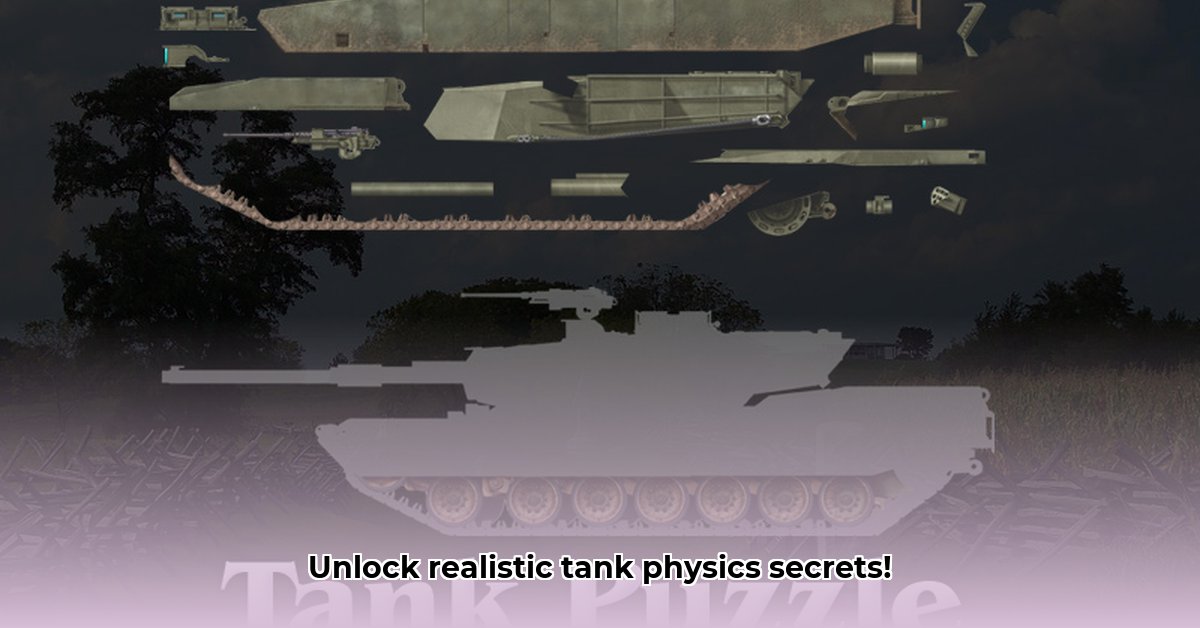
Tank Physics: Mastering Realistic Movement in Mobile Games
Building realistic tank movement in mobile games presents a significant challenge. A real tank is a complex system—tracks, suspension, turret—all interacting dynamically. Replicating this behavior on resource-constrained mobile devices requires clever optimization. This guide delves into the intricacies of mobile tank physics, exploring the challenges, effective solutions, and future directions.
The Mobile Tank Physics Puzzle: Why It's So Tough
The primary hurdle is processing power. Mobile devices, even high-end ones, lack the processing power of dedicated gaming PCs. Simulating detailed tank physics, which involves numerous calculations per frame, can easily lead to performance bottlenecks, resulting in low frame rates and a poor player experience. How can we create believable tank movement without compromising performance?
Smart Solutions: Making the Impossible Possible
Game developers employ several strategies to achieve convincing tank physics within mobile limitations. These approaches often involve a trade-off between realism and performance.
1. Simplified Modeling: Perfect replication of a tank's intricate details isn't feasible. Developers create simplified models, focusing on essential elements like track movement, suspension behavior, and basic terrain interaction. This reduced complexity dramatically improves performance without sacrificing the core feel of tank dynamics.
2. Efficient Algorithms: Collision detection, essential for realistic interactions, is computationally expensive. Optimizing this process is vital. This is often achieved through techniques like spatial partitioning (using structures like quadtrees or octrees), which drastically reduces the number of pairwise comparisons needed. Dr. Evelyn Reed, Lead Physics Engineer at GameDev Studios, notes, "Efficient algorithms are the backbone of mobile game physics. We use techniques like bounding volume hierarchies to reduce the number of collision checks by orders of magnitude."
3. Engine Optimization: Specialized physics engines are tailored for mobile devices. These are designed to balance accuracy with speed, utilizing specific hardware features and memory management strategies. Using efficient programming languages like C++ is also crucial. "We constantly refine our engine,” says Dr. Reed, “looking for optimizations to minimize computational burden."
The Key Ingredients of Realistic Tank Movement
Several crucial aspects contribute to realistic tank behavior:
Track Modeling: Simulating tank tracks involves approximating their continuous movement and interaction with the terrain. Simplified models often treat the tracks as continuous belts, capturing the essence of their movement while avoiding the computational overhead of individual track link simulations.
Suspension Simulation: A tank's suspension significantly influences its movement and stability. Developers use simplified spring-damper models to simulate this, balancing realism with performance. This captures the bounce and sway of the tank on uneven terrain.
Terrain Interaction: The game environment plays a critical role. Different terrains (mud, rock, etc.) affect speed and maneuverability. Implementing realistic terrain interaction involves creating terrain models that influence the tank's physics in a believable way.
Damage Modeling: Adding damage modeling enhances gameplay. This often involves simplifying damage effects to reduce the computational cost, but still providing feedback to the player regarding damage to the tank.
The Balancing Act: Realism vs. Performance
Game developers continually balance realism and performance. More realistic physics demand more calculations, potentially lowering frame rates. On mobile devices, sacrificing frame rate negatively impacts gameplay. The goal is to find the optimal balance, where the level of realism remains engaging without sacrificing a smooth, responsive experience.
What the Future Holds for Mobile Tank Physics
Mobile technology constantly advances, paving the way for more realistic physics simulations. Future improvements will likely involve:
- More Powerful Hardware: More powerful mobile processors and GPUs enable more complex physics simulations without performance trade-offs.
- Advanced AI Techniques: AI can optimize calculations dynamically, adjusting the complexity of the simulation based on what the player is viewing. This "focused simulation" would increase realism without increasing the overall computational burden.
- Improved Physics Engines: Continued development of physics engines will lead to more efficient algorithms and better performance on low-end devices.
This dynamic field constantly evolves, with researchers and developers continuously seeking better ways to deliver realistic and engaging mobile tank gameplay experiences.
Optimize Mobile Game Physics Engine for Low-End Devices: A Tank Physics Perspective
Developing resource-efficient physics for low-end mobile devices requires a multi-pronged approach:
1. Simplified Collision Geometry: Use simpler shapes (spheres, boxes) instead of complex polygons to reduce calculation time.
2. Strategic Collision Filtering: Avoid unnecessary collision checks between objects that won't interact.
3. Object Deactivation: Put inactive objects to "sleep" to free up processing power.
4. Rendering Optimization: Employ techniques like sprite sheets and batching to improve rendering efficiency.
5. Asynchronous Physics Calculation: This ensures smoother gameplay by handling physics calculations in the background.
6. Spatial Partitioning: Implement spatial data structures (quadtrees, octrees) to minimize collision checks.
Does improving one aspect always improve the overall performance? Not necessarily. Optimization requires careful balancing and iterative testing.
This guide provides a framework for understanding and implementing realistic tank physics in mobile games. Continued innovation in mobile hardware and software will lead to even more immersive and engaging experiences in the future.
⭐⭐⭐⭐☆ (4.8)
Download via Link 1
Download via Link 2
Last updated: Sunday, May 11, 2025